Coagulant vs Flocculant: How to Choose and Dose ETP Chemicals (with Jar Test Steps)
Most ETP chemical problems come down to the wrong product, the wrong dose or the wrong order. Here is how coagulants and flocculants work – and how a 30-minute jar test finds the right combination.
 Santosh Prajapati · Managing Director
· 7 min read
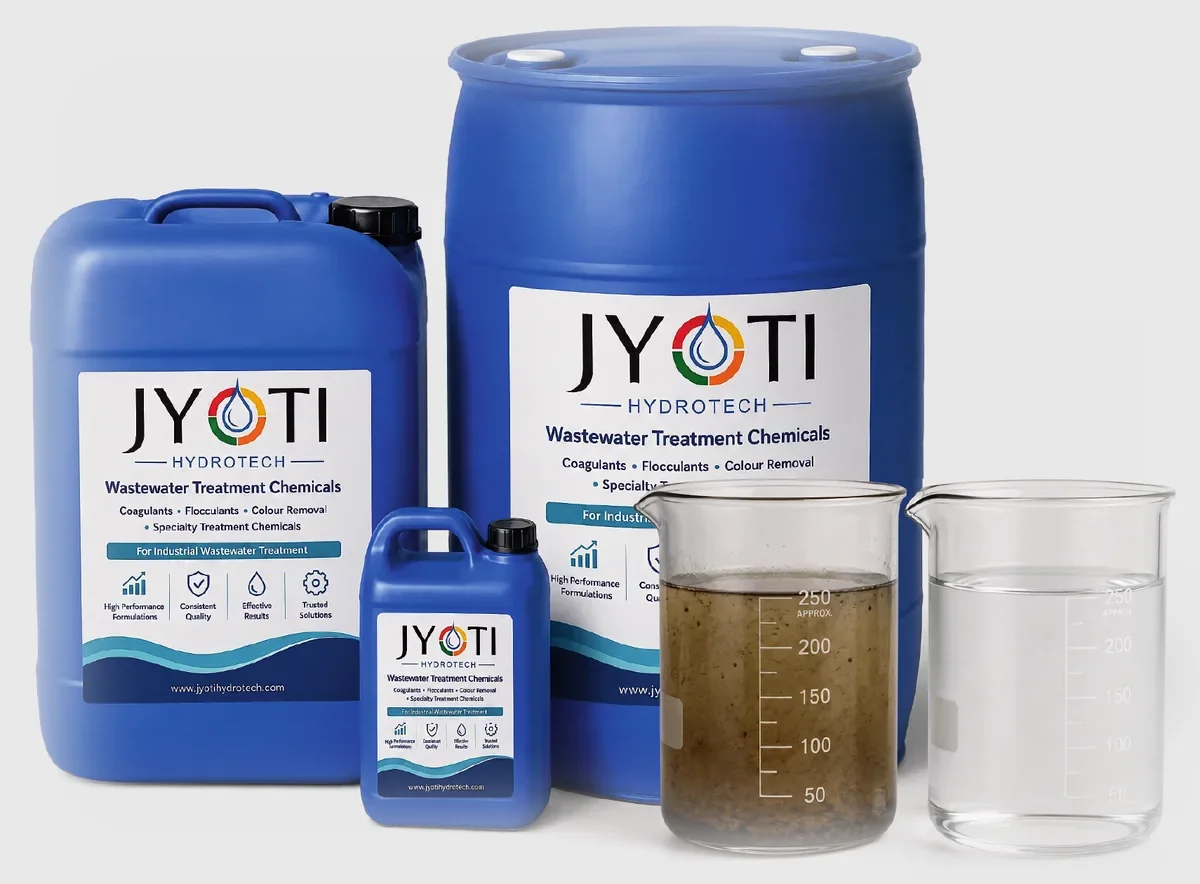
A coagulant neutralises the electrical charge on tiny suspended and colloidal particles so they can stick together into micro-flocs; a flocculant – usually a long-chain polyelectrolyte – then bridges those micro-flocs into large, heavy flocs that settle or float. The coagulant goes in first with fast mixing, the flocculant second with slow mixing, and a jar test on fresh effluent decides which products and doses to use.
What is the difference between a coagulant and a flocculant?
Fine particles in water – clay, colour, oil droplets, bacteria – carry a surface charge, usually negative. Because like charges repel, the particles stay apart and the water stays cloudy however long it stands. Treatment needs two jobs done in sequence.
| Coagulant | Flocculant | |
|---|---|---|
| Job | Neutralises particle charge | Bridges particles into large flocs |
| Typical chemistry | Alum, PAC, ferric salts, organic coagulants | Anionic, cationic or non-ionic polyelectrolytes |
| Floc produced | Small pin-flocs (micro-flocs) | Large, strong flocs that settle or float |
| Mixing | Rapid mix – seconds to a minute | Gentle mix – several minutes |
| Order | First | Second |
Which coagulant should you use – alum, PAC, ferric or organic?
Each coagulant family has a place. The jar test decides, but these are the usual trade-offs:
| Coagulant | Strengths | Watch out for |
|---|---|---|
| Alum (aluminium sulphate) | Low cost, widely available | Consumes alkalinity and lowers pH; works in a narrow pH band; more sludge |
| PAC (poly aluminium chloride) | Pre-polymerised, works over a wider pH range, smaller pH drop, fast floc | Costs more per kg than alum – compare on cost per m³ treated |
| Ferric chloride / ferrous sulphate | Strong on colour, phosphorus and some metals; heavy floc | Corrosive; lowers pH; can tint the water if overdosed |
| Organic coagulants (e.g. polyamine, polyDADMAC) | Very low dose, little extra sludge, no added metal | Higher price per kg; often used together with an inorganic coagulant |
| Blended coagulants | Combine inorganic and organic action in one product | Must be matched to the effluent by testing |
Jyoti manufactures coagulants for specific effluents – for example JC-709 (organic and inorganic blend), JC-723 (cationic), JC-724 (organic), JC-716 (textile), JC-717 (chemical industry) and JC-731 (edible oil). See the full wastewater chemicals range.
Anionic, cationic or non-ionic polyelectrolyte – which one?
| Type | Commonly used for |
|---|---|
| Anionic polyelectrolyte | Flocculating mineral and inorganic solids, and flocs formed by metal coagulants such as alum, PAC or ferric |
| Cationic polyelectrolyte | Organic and biological solids, and sludge conditioning before a screw press, filter press or centrifuge |
| Non-ionic polyelectrolyte | Some acidic or mineral-rich streams where a charged polymer performs poorly |
Jyoti supplies high-molecular-weight anionic (JC-700), cationic (JC-701) and non-ionic (JC-702) polyelectrolytes. A quick polymer screen in the jar test shows which gives the biggest, strongest floc.
How do you do a jar test? Step by step
The jar test is the standard bench method for comparing coagulants and coagulant aids on the same water under the same conditions – ASTM D2035 describes it as a procedure for coagulation-flocculation followed by gravity settling. You need a gang stirrer with four to six paddles, 1-litre beakers, syringes or pipettes, a pH meter and, ideally, a turbidity meter.
- Take a fresh, representative sample from the equalisation tank outlet – effluent changes with time.
- Fill the beakers with the same volume, typically 1 L each, and note pH and temperature.
- Adjust pH if your plant does, so the test matches real conditions.
- Dose the coagulant in a rising series across the jars – for example a different dose in each of six jars.
- Rapid mix to disperse it – one widely used procedure flash-mixes at 200 rpm for 30 to 60 seconds.
- Add the flocculant at the planned dose.
- Slow mix to grow flocs – about 20 to 30 rpm; lengthen this step to match your plant’s flocculator time.
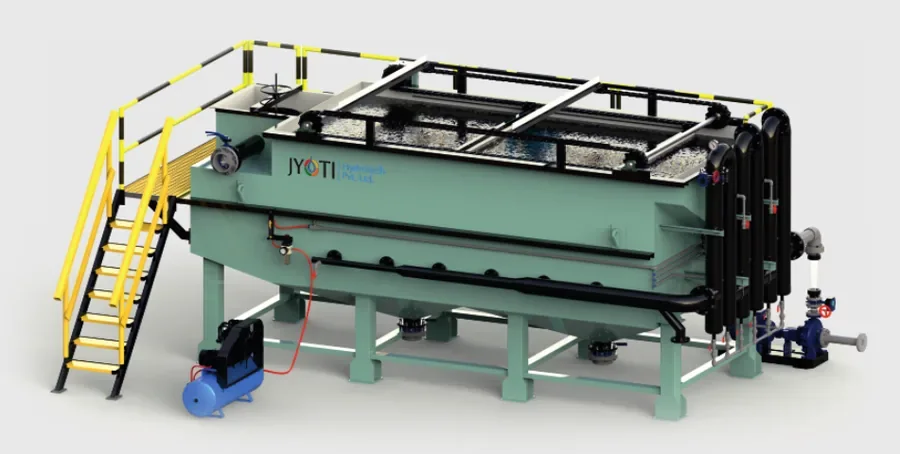
- Stop and settle – watch how fast and how cleanly the floc drops (or floats, if you run a DAF).
- Measure the clear water – turbidity, colour and COD of the supernatant, plus pH.
- Pick the winner – the lowest-cost combination that reliably meets your target, not just the clearest jar.
| Jar | 1 | 2 | 3 | 4 | 5 | 6 |
|---|---|---|---|---|---|---|
| Coagulant dose (mg/L) | ||||||
| Flocculant dose (mg/L) | ||||||
| pH after dosing | ||||||
| Floc size / settling | ||||||
| Supernatant turbidity / colour | ||||||
| COD (if tested) |
Jar test record sheet – copy it into your lab register.
How do you calculate chemical dose and daily consumption?
Once the jar test gives a dose in mg/L, scaling it up is simple arithmetic:
Example: a jar test shows 80 mg/L of coagulant works best and the ETP treats 500 m³/day. Consumption is 80 × 500 ÷ 1,000 = 40 kg/day of product. If the product is supplied as a liquid, convert using its strength and density from the technical data sheet.
Set the dosing pump for this figure, then confirm in the plant: collect a timed sample from the dosing line and check the actual flow at least once a week.
Why are flocs small, or why is the water still cloudy?
| What you see | Likely cause | What to do |
|---|---|---|
| Pin-flocs that do not grow | Coagulant under-dosed or pH outside its working range | Re-run jar test; correct pH first |
| Clear jar at low dose, cloudy at higher dose | Overdosing – particles re-stabilise | Reduce the dose to the optimum zone |
| Good flocs that break up | Too much shear – pumps, sharp bends or over-mixing | Dose flocculant closer to the clarifier; gentler mixing |
| Flocs float when they should settle | Gas, oil or air in the floc | Consider a DAF, or remove the gas source |
| Results drift week to week | Effluent mix changes, or old polymer solution | Jar test after recipe changes; make polymer fresh |
| Sludge will not dewater | Wrong polymer for the press | Screen cationic polymers on the actual sludge |
How does your chemical choice change sludge cost?
Every kilogram of metal coagulant adds solids to the sludge you must dewater and dispose of. Moving part of the job to an organic coagulant, removing oil before chemical dosing, and avoiding overdosing all reduce the chemical sludge. On many plants, sludge disposal costs as much attention as the chemical bill.
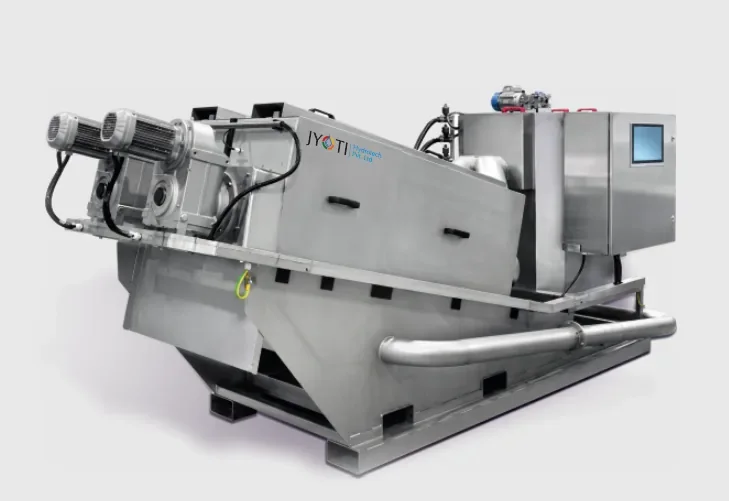
Dewatering equipment such as the Jyoti screw press needs a well-conditioned sludge – usually with a cationic polyelectrolyte selected on the actual sludge.
Can Jyoti run the jar test for my plant?
Yes. Jyoti’s laboratory in Surat runs jar tests and treatability studies on your effluent sample and recommends a chemical programme with doses – from coagulants and polyelectrolytes to defoamers, RO chemicals and bio-cultures.
Key takeaways
- Coagulant first (charge neutralisation, rapid mix), flocculant second (bridging, slow mix).
- PAC works over a wider pH range than alum; organic coagulants cut sludge; ferric is strong on colour and phosphorus.
- Anionic polymers usually follow metal coagulants; cationic polymers suit organic and biological sludges.
- Use a jar test to find the lowest effective dose – overdosing makes water worse, not better.
- Daily chemical (kg) = dose (mg/L) × flow (m³/day) ÷ 1,000.
Frequently asked questions
Is alum a coagulant or a flocculant?
Alum is a coagulant. It neutralises particle charge and forms small flocs; a polyelectrolyte flocculant is usually added afterwards to build larger flocs.
Is polyelectrolyte a coagulant or a flocculant?
Most polyelectrolytes used in ETPs are flocculants – long-chain polymers that bridge particles. Some low-molecular-weight cationic polymers act as organic coagulants.
Which is added first, coagulant or flocculant?
The coagulant is added first with rapid mixing; the flocculant is added after it with slow, gentle mixing.
What is PAC in water treatment?
PAC is poly aluminium chloride, a pre-polymerised aluminium coagulant. Compared with alum it typically works over a wider pH range and lowers the pH less.
What rpm is used in a jar test?
A common procedure uses rapid mixing at about 200 rpm for 30–60 seconds after the coagulant, then slow mixing at about 20–30 rpm to form floc. Plants adjust times to match their own mixing tanks.
Why does too much coagulant make water cloudy again?
Overdosing can reverse the particle charge, so particles repel each other again and stay suspended. That is why the jar test looks for an optimum dose, not the maximum.
What is the difference between anionic and cationic polyelectrolyte?
They carry opposite charges. Anionic types are widely used after metal coagulants for inorganic solids; cationic types suit organic and biological solids and sludge dewatering.
How do you calculate coagulant dose for an ETP?
Find the optimum dose in mg/L with a jar test, then multiply by the daily flow in m³ and divide by 1,000 to get kilograms per day.

Santosh Prajapati founded Jyoti Hydrotech Pvt. Ltd. in Surat in 1993 and leads the company as Managing Director. Under his leadership Jyoti has designed, built and run water and wastewater treatment plants for Indian industry – ETP, STP, RO, ZLD and more – and exported systems to eight countries.